
Code is Too Hard To Think About

1920

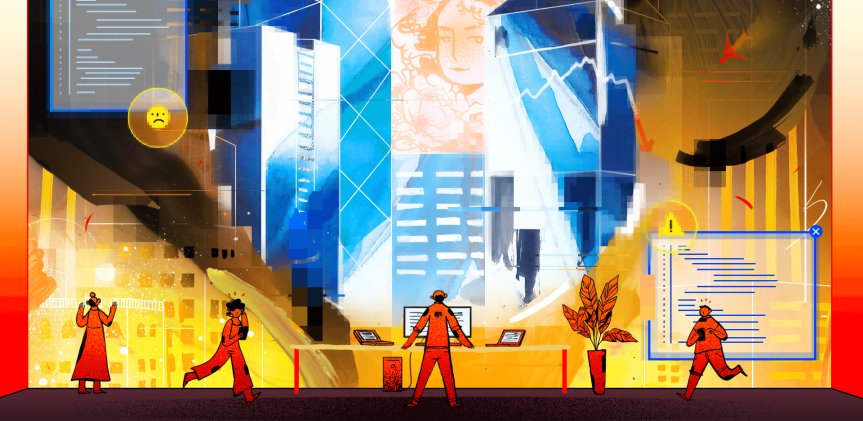
here were six hours during the night of April 10, 2014, when the entire population of Washington State had no 911 service. People who called for help got a busy signal. One Seattle woman dialed 911 at least 37 times while a stranger was trying to break into her house. When he finally crawled into her living room through a window, she picked up a kitchen knife. The man fled.

The 911 outage, at the time the largest ever reported, was traced to software running on a server in Englewood, Colorado. Operated by a systems provider named Intrado, the server kept a running counter of how many calls it had routed to 911 dispatchers around the country. Intrado programmers had set a threshold for how high the counter could go. They picked a number in the millions.

Shortly before midnight on April 10, the counter exceeded that number, resulting in chaos. Because the counter was used to generating a unique identifier for each call, new calls were rejected. And because the programmers hadn’t anticipated the problem, they hadn’t created alarms to call attention to it. Nobody knew what was happening. Dispatch centers in Washington, California, Florida, the Carolinas, and Minnesota, serving 11 million Americans, struggled to make sense of reports that callers were getting busy signals. It took until morning to realize that Intrado’s software in Englewood was responsible, and that the fix was to change a single number.

https://www.theatlantic.com/technology/archive/2017/09/saving-the-world-from-code/540393/

When a tanker vanishes, all the evidence points to Russia | WIRED UK

As the 184-metre-long tanker was docking in Novorossiysk, Le Meur was on the ship’s bridge overseeing the final approach. Suddenly, the ship’s warning signals started blaring. “As soon as the GPS lost the signal, we had tons of alarms,” he says. “You cannot miss it. Pretty much everything on the bridge started raising alarms.”

Instead of displaying Atria’s actual position, the ship’s systems located it 25 to 30 miles away – at Gelendzhik airport. GPS disruptions aren’t uncommon, Le Meur says, but most of the time when problems happen they’re limited to a few hundred metres.

“In my entire career, it’s my first time I have experienced such a big discrepancy.” To be sure of the failure during the incident in June, the crew restarted both the main GPS and the backup unit, only to find both systems still gave the same incorrect positioning data.

https://www.wired.co.uk/article/black-sea-ship-hacking-russia

Bill Gates has made the move to Android, has no love for an iPhone – Neowin

It may not be the most surprising revelation, given profits are sinking faster than a boat without a hulland big-name partners are jumping ship left and right, but the founder of Microsoft has presumably left Windows Mobile for the greener pastures of Google’s Android.

https://www.neowin.net/news/bill-gates-has-made-the-move-to-android-has-no-love-for-an-iphone

Apple is really bad at design | The Outline

The “notch” on the new iPhone X is not just strange, interesting, or even odd — it is bad. It is bad design, and as a result, bad for the user experience. The justification for the notch (the new Face ID tech, which lets you unlock the device just by looking at it) could have easily been accomplished with no visual break in the display. Yet here is this awkward blind spot cradled by two blobs of actual screenspace.

https://theoutline.com/post/2352/apple-is-really-bad-at-design

Moscow Deploys Facial Recognition to Spy on Citizens in Streets – Bloomberg

Moscow is adding facial-recognition technology to its network of 170,000 surveillance cameras across the city in a move to identify criminals and boost security.

Since 2012, CCTV recordings have been held for five days after they’re captured, with about 20 million hours of video stored at any one time.

https://www.bloomberg.com/news/articles/2017-09-28/moscow-deploys-facial-recognition-to-spy-on-citizens-in-streets

Cloudflare CEO: DDoS Attacks Will Now Be ‘Something You Only Read About In The History Books’ – Motherboard

Cloudflare, a major internet security firm, is on a mission to render distributed denial-of-service (DDoS) attacks useless. The company announced Monday that every customer—including those who only use its free services—will receive a new feature called Unmetered Mitigation, which protects against every DDoS attack, regardless of its size.

https://motherboard.vice.com/en_us/article/59dd5q/cloudflare-ceo-ddos-attacks-will-now-be-something-you-only-read-about-in-the-history-books